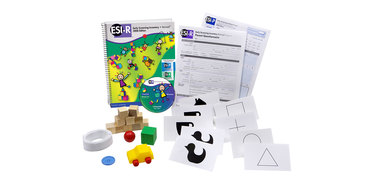
Early Screening Profiles (ESP) is an indispensable tool that uses multiple domains, settings, and sources to measure cognitive, language, motor, self-help, and social development.
Early Screening Profiles
ESP
Early Screening Profiles (ESP) is an indispensable tool that uses multiple domains, settings, and sources to measure cognitive, language, motor, self-help, and social development.
Overview
Product Details
- Age range:
- 2:0-6:11
- Qualification level:
- B
- Completion time:
-
15-40 minutes
- Scoring options:
- Manual scoring
ESP provides practical information to help professionals in educational, medical, or community settings make accurate screening decisions and plan intervention strategies.
Benefits
- Provides an excellent predictor of later development and school achievement.
- Meets federal guidelines and mandates.
- The first nationally standardized screener to provide users with a manual that reports the results of predictive, concurrent, and construct validity studies conducted during the two-year time period between standardization and test publication.
- Allows appropriate comparisons of children with others the same age in the U.S. The scoring system also provides simple determination of local norms.
- Links directly to many other diagnostic tools, such as the K-ABC, Vineland Adaptive Behavior Scales, Bruininks-Oseretsky Test of Motor Proficiency, and others.
Features
Three basic profiles are supplemented by four surveys. Administer all or just the ones needed.
- Cognitive/Language Profile: assess reasoning skills, visual organization and discrimination, receptive and expressive vocabulary, and basic school skills.
- Motor Profile: assess both gross and fine motor skills such as walking a straight line, imitating arm and leg movements, tracing mazes, and drawing shapes.
- Self-Help/Social Profile: a questionnaire completed by the child's parent, teacher, daycare provider, or a combination of them.
- Articulation Survey: measures the child's ability to pronounce 20 words selected to test common articulation problems in the initial, medial, and final positions of words.
- Home Survey and Health History Survey: completed by the parent and cover non-intrusive questions about the child's home environment, plus a brief checklist of any health problems the child has had.
- Behavior Survey: used by the examiner to rate the child's behavior during administration of the Cognitive/Language and Motor Profiles. The child is rated in categories such as attention span, frustration tolerance, and response style.
Resources
The following resources are available for ESP.