Now Available on Q-global!PCTA distributes but does not publish this product.
Autism Spectrum Rating Scales
ASRS
The Autism Spectrum Rating Scales (ASRS™) provides the first nationally standardized, norm-referenced ASD Rating Scale. This multi-informant measure helps identify symptoms, behaviors, and associated features of Autism Spectrum Disorders (ASDs) in children and adolescents aged 2 to 18 years.Now Available on Q-global!PCTA distributes but does not publish this product.
- Age range:
- 2 - 18
- Publication date:
- 2009
- Qualification level:
- B
- Completion time:
- Full form: 20 minutes, Short form: 5 minutes (15 items)
- Administration:
- Q-global or paper-and-pencil
- Scores/Interpretation:
- Q-global or manual scoring
The ASRS scale is an easy-to-use, norm-referenced assessment designed to identify symptoms, behaviors, and associated features of the full range of Autism Spectrum Disorders. Parents and teachers are asked to evaluate how often they observe specific behaviors in the child or adolescent in areas such as socialization, communication, unusual behaviors, behavioral rigidity, sensory sensitivity, and self-regulation. The ASRS was designed to effectively identify symptoms, behaviors, and associated features of Autism Spectrum Disorders (ASDs) in children and adolescents aged 2 to 18, and links in with DSM-5.
Norms
The ASRS was standardized on 2,560 non-clinical cases from across the United States. The standardization included 640 cases for the ASRS (2 to 5 Years) with 320 parent and 320 teacher forms and 1,920 cases for the ASRS (6 to 18 Years) with 960 parent and 960 teacher forms. Over 1,200 clinical cases were also collected. The disorders in the clinical sample include:
- Autism Spectrum Disorder (Autism, Asperger's, Pervasive Developmental Disorder - Not Otherwise Specified)
- Attention-Deficit/Hyperactivity Disorder
- Mood and Anxiety Disorders
- Disruptive Behavior Disorders
- And many more
Reliability
The ASRS was found to demonstrate high levels of internal consistency (alpha ranging from .74 to .97). Test-retest reliability scores were computed for the ASRS scores over a 2- to 4-week interval. Overall, the test-retest values indicate excellent test-retest reliability (ranging from .72 to .93).
Validity
A series of discriminant function analyses were conducted in order to determine the ability of the scores to predict group membership in the Autism Spectrum Disorder or General Population groups. On average, the scales were able to very accurately predict group membership, with a mean overall correct classification rate of 92%.
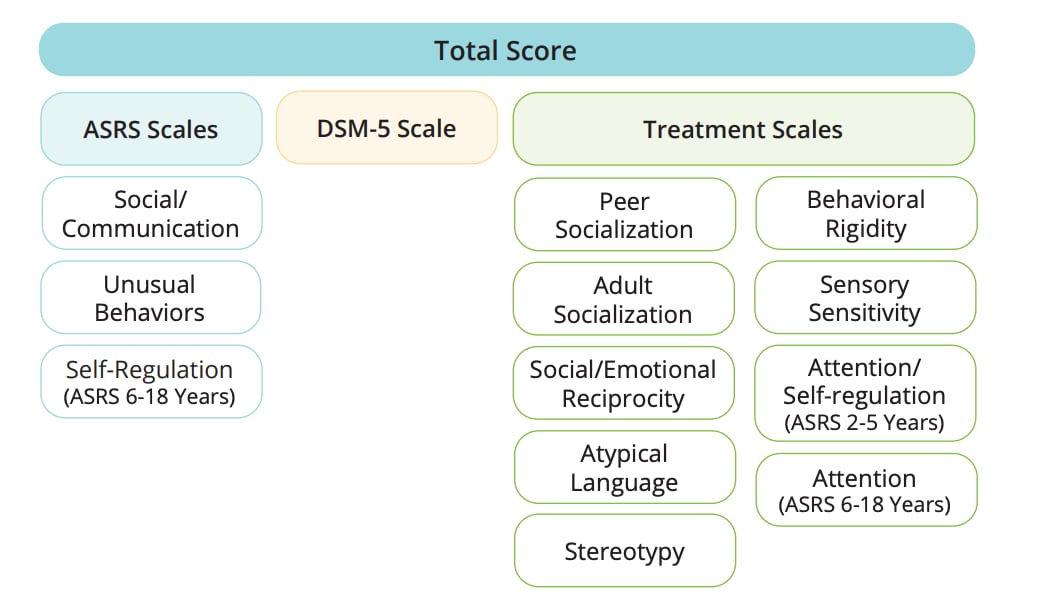
Key Areas Measured:
- Total ASRS Score
- DSM-5 Scale
- ASRS Scales:
-
- Social/Communication
- Unusual Behaviors
- Self-Regulation (ages -18 yrs)
- Treatment Scales:
- Peer Socialization
- Adult Socialization
- Social/Emotional Reciprocity
- Atypical Language
- Stereotypy
- Behavioral Rigidity
- Sensory Sensitivity
- Attention/Self-Regulation (ages 2-5 yrs)
- Attention (ages 6-18 years)
The ASRS scale is an easy-to-use, norm-referenced assessment designed to identify symptoms, behaviors, and associated features of the full range of Autism Spectrum Disorders. Parents and teachers are asked to evaluate how often they observe specific behaviors in the child or adolescent in areas such as socialization, communication, unusual behaviors, behavioral rigidity, sensory sensitivity, and self-regulation. The ASRS was designed to effectively identify symptoms, behaviors, and associated features of Autism Spectrum Disorders (ASDs) in children and adolescents aged 2 to 18, and links in with DSM-5 symptom criteria.
ASRS Scale Structure and Scoring Domains

In each episode, you’ll meet someone who makes a profound difference in other people’s wellbeing every single day.
- English
- A digital manual is included with the purchase of ASRS Q-global score reports. All digital ASRS users will get access to the manual on Q-global.
- We currently offer a single-rater interpretive report.
- Yes. The report is available for download as both a .doc and .pdf.
- Yes. ASRS on Q-global offers the following forms in both English and Spanish: ASRS Parent/Caregiver (2-5), ASRS Parent/Caregiver (6-18), ASRS Teacher/Childcare Provider (2-5), ASRS Teacher/Childcare Provider (6-18), ASRS Short-Form (2-18)
- You have the option to print paper forms from Q-global to give to the parents or teachers. When the form is returned to you, you can enter the scores manually into Q-global and generate the report. You can print as many forms as you need. You will not be charged for the use until it is entered, scored, and a report is generated.
- No, the content is the same, we have just made ASRS available on our digital platform, Q-global.
- ASRS is available for DALS users under the new MHS Education 2025 Portfolio. If you currently have the MHS Education portfolio (for Conners 4™) and would like ASRS added before your DALS license renews, contact your Pearson Consultant to discuss how you can get DALS access to the ASRS.